When Uganda’s school games kick off each season, the scale is impossible to miss thousands of students, dozens of sports, national championships, regional qualifiers and international trips stretching from Africa to Europe and Asia.
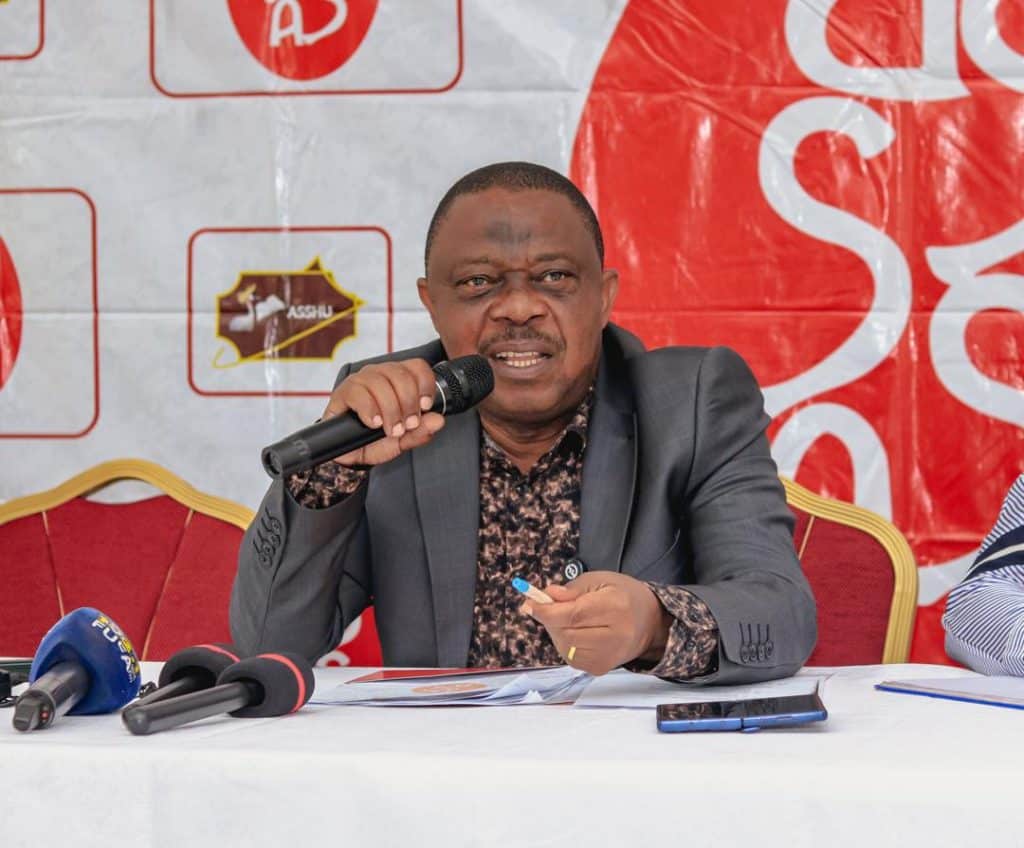
That reality came into sharp focus on Wednesday morning at GNS Plaza, where Uganda Secondary Schools Sports Association (USSSA) president Justus Mugisha spoke frankly about the state of school sports and why current government funding no longer matches the workload.
“We receive seven billion shillings from government,” Mugisha said. “But when you look at the activities we handle, it’s not enough. Maybe it could go to 17 billion, but to fully satisfy schools, it should be around 23 billion.”
It was not a complaint, but a clear-eyed assessment of an association that is growing faster than its budget.
At the centre of USSSA’s reforms is a push toward digital management. Mugisha confirmed that online registration for the 2026 season opened on October 31, 2025 and will close on March 27, 2026, a move aimed at improving efficiency and accountability.
A Shs10,000 transfer fee per athlete has also been introduced to properly track player movement, while a Competition Management System is now active across football, netball, basketball, volleyball and handball.
For an organisation coordinating competitions nationwide, Mugisha said these systems are now a necessity, not a luxury.
Hosting requirements have also been tightened. While hosting remains rotational, priority is now given to schools with strong facilities or those willing to upgrade in partnership with USSSA.
With several school competitions now televised, Mugisha stressed that standards must reflect the exposure.
“We must protect the image of school sports,” he said, insisting host schools meet strict benchmarks.
USSSA is also close to acquiring its own land, a major step that would allow the association to host championships for up to 2,000 athletes and reduce reliance on borrowed venues.
Mugisha reminded stakeholders that his term, which began in 2022, officially ends this year. A Returning Officer has already been appointed at the AGM, paving the way for elections from district to national level in line with the USSSA Constitution.
The emphasis, he said, is on institutional strength rather than individual leadership.
Athletics, a core pillar of school sport, has been restructured. The season will now include two athletics meets February to March and April to May, followed by a national training camp in May.
District qualifiers will be held in May, zonal qualifiers in June and national championships in July. A residential camp will then prepare athletes for the FEASSA Games in August in Morogoro, Tanzania.
“Structure is the difference between participation and excellence,” Mugisha noted.
Despite limited funds, USSSA will represent Uganda in six international championships this year.
Teams will compete in handball in North Macedonia, basketball in Serbia, football and volleyball in China, golf in Morocco and the ISF Gymnasiade, with the host country yet to be announced.
“These opportunities change young lives,” Mugisha said. “But they come at a cost.”
The USSSA Elite Games are scheduled for February 26 to March 1, 2026 at Janan Secondary School in Bombo, pending final inspections. Mugisha expressed confidence in the school’s readiness.
USSSA is also expanding its sports menu. Baseball, softball and Baseball 5 will be introduced, alongside demonstration sports such as cricket, golf, kabaddi, kho kho and pickleball, all open to both boys and girls.
The aim, Mugisha said, is to keep school sport inclusive and accessible.
One of the most striking points of Mugisha’s address was the growing influence of international schools.
“A few years ago, we encouraged international schools to join,” he said. “The truth is, without them, we might not be FEASSA champions. Most of our gold-winning swimmers came from international schools.”
He pointed to Uganda’s recent ISF Volleyball participation in China, where one team was largely made up of white players, a reflection, he said, of inclusion rather than exclusion.
“We are becoming one,” Mugisha said, acknowledging challenges around different academic calendars. USSSA plans to co-opt a representative of international schools onto its executive to improve coordination.
Beyond talent, Mugisha admitted their financial muscle also matters. “There are sports where they are much better resourced than us. In China, we could only send one team. One parent paid tickets for all their players. Don’t you think we need such people?”
As Mugisha wrapped up, the contrast showed an association modernising systems, expanding sports, competing internationally and pushing for world class standards, all on Shs7 billion.