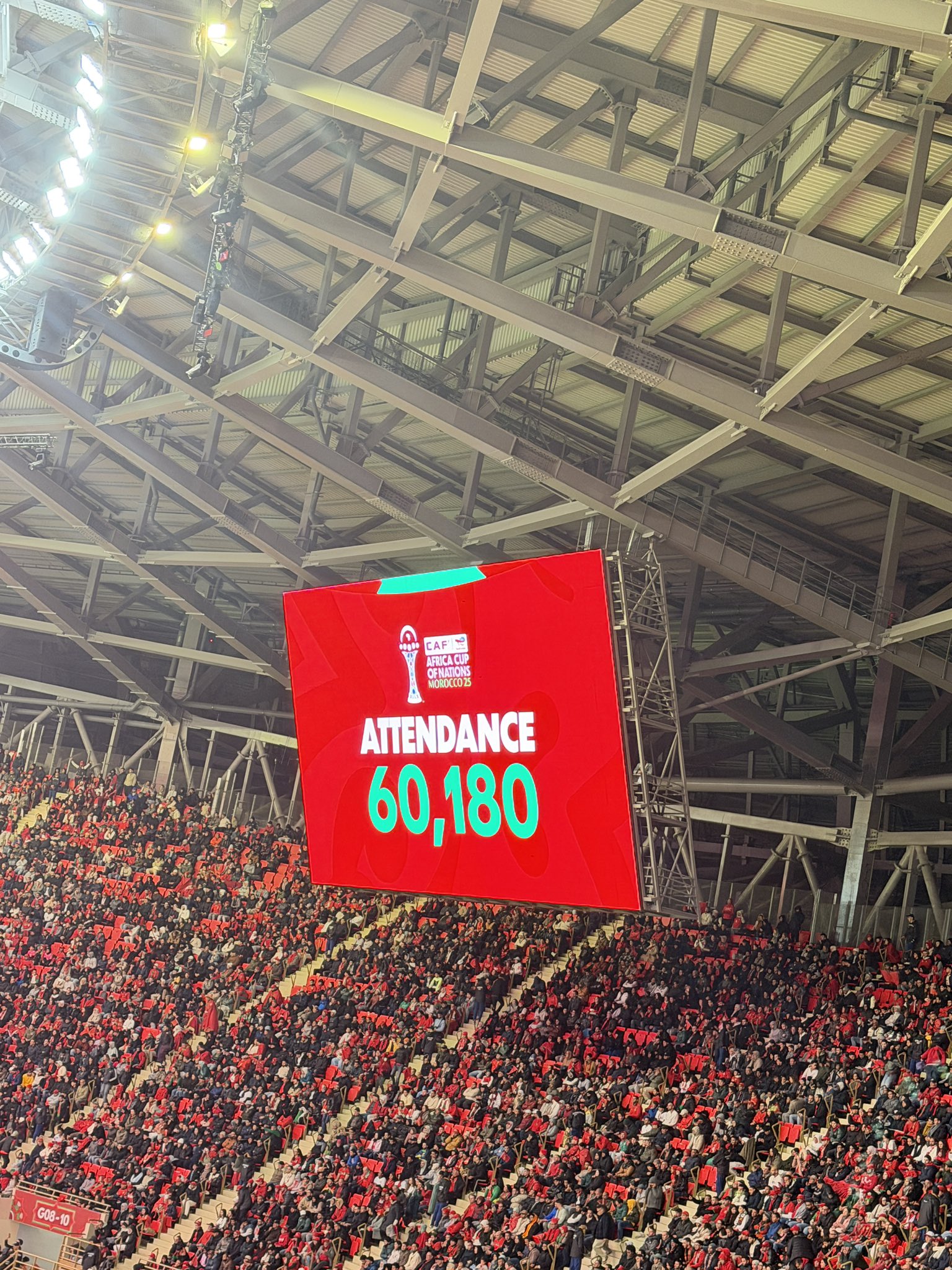
The image has become painfully familiar in African football. Stadiums are officially sold out, yet rows of empty seats stare back from the stands.
Outside, fans wait helplessly, unable to reach tickets or facing prices inflated to absurd levels by black-market dealers.
Ugandans witnessed this during the CHAN tournament hosted by the PAMOJA nations of Uganda, Kenya, and Tanzania.
Now, at the Africa Cup of Nations in Morocco, the problem has returned louder, clearer and more damaging.
At the heart of the issue lies a broken connection between football and the people it is meant to serve.
Morocco and neighboring Algeria were the only teams whose group-stage tickets officially sold out.
Yet when the Atlas Lions faced Mali on Friday night at the nearly 70,000-capacity Prince Moulay Abdellah Stadium in Rabat, thousands of seats remained empty.
Official attendance read 63,844, impressive on paper, but the gaps in the stands told a different story.
Outside the stadium, fans like Amin Mazraoui felt the contradiction in an article on AP news. “I tried to log in early, but the site was full. So many people were trying at the same time that I couldn’t get a ticket,” he said, waiting in vain as kickoff approached.
Hicham shared the same frustration. He tried to buy tickets through the official portal, only to find every match sold out almost instantly.
With no alternatives, he resigned himself to watching from home, not by choice, but by exclusion.
Meanwhile, the black market thrived. Touts scooped up tickets to the most popular games, seeing profit before passion.
Reports suggested tickets originally priced at 50 euros were being resold for as much as 500, ten times their value.
For many local fans, especially young people and families, football had become a luxury they could no longer afford in their own country.
The consequences go beyond ticketing. Empty seats drain the atmosphere from matches, rob players of home support, and weaken the spectacle that broadcasters pay for.
More importantly, they alienate loyal supporters, the very backbone of African football. When fans lose trust in the system, they disengage. And when football loses its people, it loses its soul.
In my opinion as Jeremiah Mugalu, Stopping the black market is not simple, but it is possible. Ticketing systems must prioritize real fans.
ID-linked tickets, purchase limits, and QR or biometric verification at entry can prevent mass buying by touts. If tickets cannot be transferred easily for profit, their black-market value collapses.
Enforcement must follow. Selling tickets at inflated prices should carry real consequences. Visible crackdowns around stadiums and online resale platforms make it clear that football authorities are serious.
Clubs and federations can also engage supporters directly. Reserved quotas for registered fan groups, local residents, and community programs ensure that seats are filled by those who bring energy to the stands, not those chasing profit.
CAF and host nations must also rethink how they measure success. Empty seats should not be treated as statistics but as failures. Transparent sales, distribution audits, and post-match accountability should become standard practice.
African football is at its best when the stands are alive drums beating, voices rising, colours waving. That energy cannot be bought. It must be protected.
Must have started way before, witnessed in 2024 Pamoja CHAN – East Africa same at the 2025 AFCON in North Africa, the lesson is clear, if football authorities do not close the door on ticket touts, they risk closing the hearts of the fans.
Protecting the fans is not just about tickets. It is about fairness, trust, and preserving the game as a shared celebration, not a commodity for exploitation.