
The Ugandan local football governing body, the Federation of Uganda Football Associations (FUFA), has published the outcome of the stadium assessment exercise conducted as part of the club licensing process ahead of the 2026/27 season.
The report shared on Tuesday evening contained a list of approved club venues, along with detailed reasons attached for the non-approval of each rejected stadium.
The assessment, carried out by the FUFA Club Licensing Committee, sought to determine whether venues meet the minimum infrastructure, safety, and operational standards required to host top-flight football matches in Uganda.

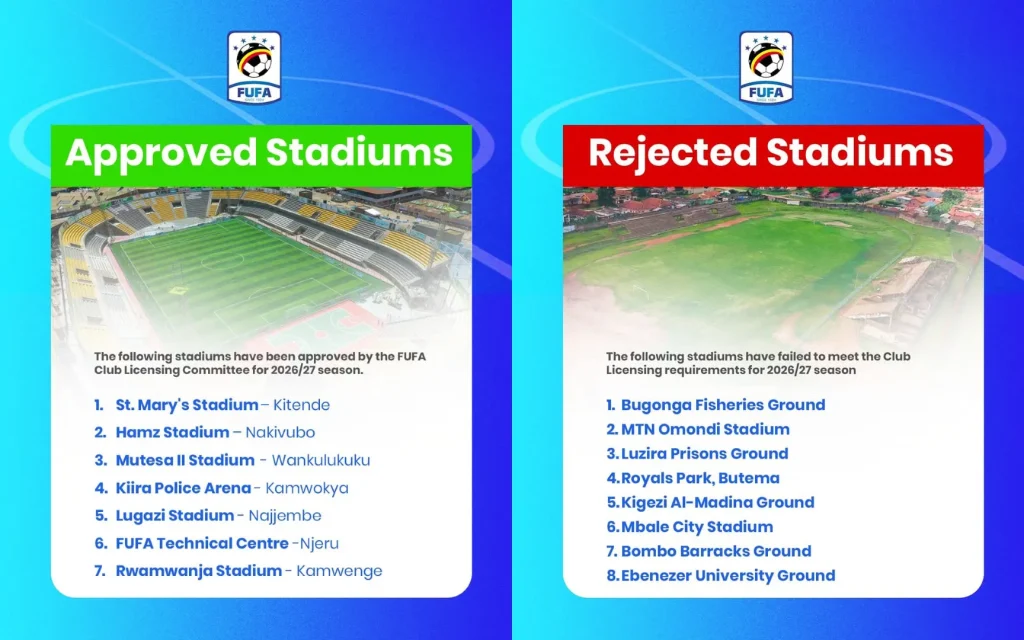
Out of the 15 venues inspected, only seven met the required standards and were given the green light to host matches during the upcoming campaign. These include St. Mary’s Stadium in Kitende, Hamz Stadium-Nakivubo, Mutesa II Stadium in Wankulukuku, Kira Police Arena, Lugazi Stadium, FUFA Technical Centre in Njeru, and Rwamwanja Stadium in Kamwenge.
Meanwhile, eight venues failed to secure approval after inspectors identified a number of shortcomings ranging from poor playing surfaces to inadequate facilities for players, officials, fans, and the media tribune.
The rejected venues are Bugonga Fisheries Ground, MTN Omondi Stadium, Luzira Prisons Ground, Royal’s Park Butema, Kigezi Al-Madina Ground, Mbale City Stadium, Bombo Barracks Ground, and Ebenezer University Ground.
For Omondi Stadium in Lugogo, the artificial playing turf is significantly worn out and has deteriorated to a very poor state. Of particular concern is the condition of the goal areas, which pose a serious risk of injury to players.
Other reasons for its rejection included technical benches that do not meet required standards and floodlights assessment indicating an average illumination of 503 lux, falling short of the minimum average lux requirement stipulated in stadium regulations.
Beyond Lugogo’s artificial turf, the seven natural grass grounds suffered similar issues, including bare patches, uneven surfaces, and a lack of general maintenance such as spiking, pest management, raking, mowing, rolling, and grass planting.
Furthermore, these natural grass venues lack basic drainage channels, have substandard technical benches and dressing rooms, and feature no dedicated medical rooms for players and match officials.
The list of issues to address before the season begins also includes inadequate sanitary facilities, fragile internal perimeter walls, a lack of physical separation for fans, and no secure tunnel or entrance for players moving from the dressing room to the pitch.
Now that venue managers are aware of the exact requirements needed to secure licensing for the forthcoming season, clubs are working around the clock to fix these issues, while others are opting for a change of hosting ground.